Did you know that failing to meet the 2026 compliance targets could effectively block the sale of your Northern NSW property? It is a stressful thought, especially when you are already trying to figure out how to get septic systems organised for a new build or an upgrade. We understand that the transition from the council's education phase to strict enforcement feels like a moving target. You are likely worried about Section 68 approvals, the risk of a failed soil percolation test, or getting hit with an unexpected $1,903.00 application fee like those currently seen in the Tweed Shire.
Most homeowners find the technical jargon and varying council fees across Ballina, Byron, and the Clarence Valley incredibly confusing. This guide provides a clear roadmap to help you secure legal compliance and choose the right system for your soil type without the stress of hidden fees. We will walk through the three-phase journey of assessment, approval, and expert installation, ensuring your wastewater is managed by a reliable local expert who values honest, transparent billing based on hourly labour and material markup.
Key Takeaways
- Understand why unsewered blocks in regions like Grafton or Bangalow require a compliant On-site Sewage Management System (OSMS) to protect the local environment.
- Learn the essential steps of how to get septic approval by coordinating a Land Capability Assessment and lodging a Section 68 application with your local council.
- Identify the right system for your property by comparing upfront installation costs with long-term maintenance requirements based on your household's size.
- Prepare for the logistical reality of installation day, from managing narrow rural site access to positioning heavy concrete or poly tanks with excavators.
- Partner with a reliable local expert who offers financial transparency through a straightforward hourly labour and material markup fee structure.
What Does it Mean to 'Get Septic' on Your Property?
When you move onto an unsewered block in regions like Grafton or Bangalow, you effectively become your own mini-utility provider. Instead of flushing your waste into a council-maintained network, you must manage it within your property boundaries using an On-site Sewage Management System (OSMS). These Onsite sewage facilities (OSSF) are designed to treat and dispose of wastewater safely without contaminating local groundwater or neighbouring land. It is a significant shift in lifestyle. In town, sewage is a passive service. On a rural or semi-rural property, it is an active responsibility that requires regular oversight and a clear understanding of your system's limits.
The environmental stakes are high in Northern NSW. Our local ecosystems are sensitive, and a failing system can lead to unregulated pollution. This is why the NSW Government has moved toward stricter enforcement, targeting 2026 for improved compliance across the state. You aren't just installing a tank; you are setting up a long-term environmental management programme. Understanding how to get septic systems right from the start prevents expensive repairs and potential council fines later on.
The Difference Between Conventional and Aerated Systems
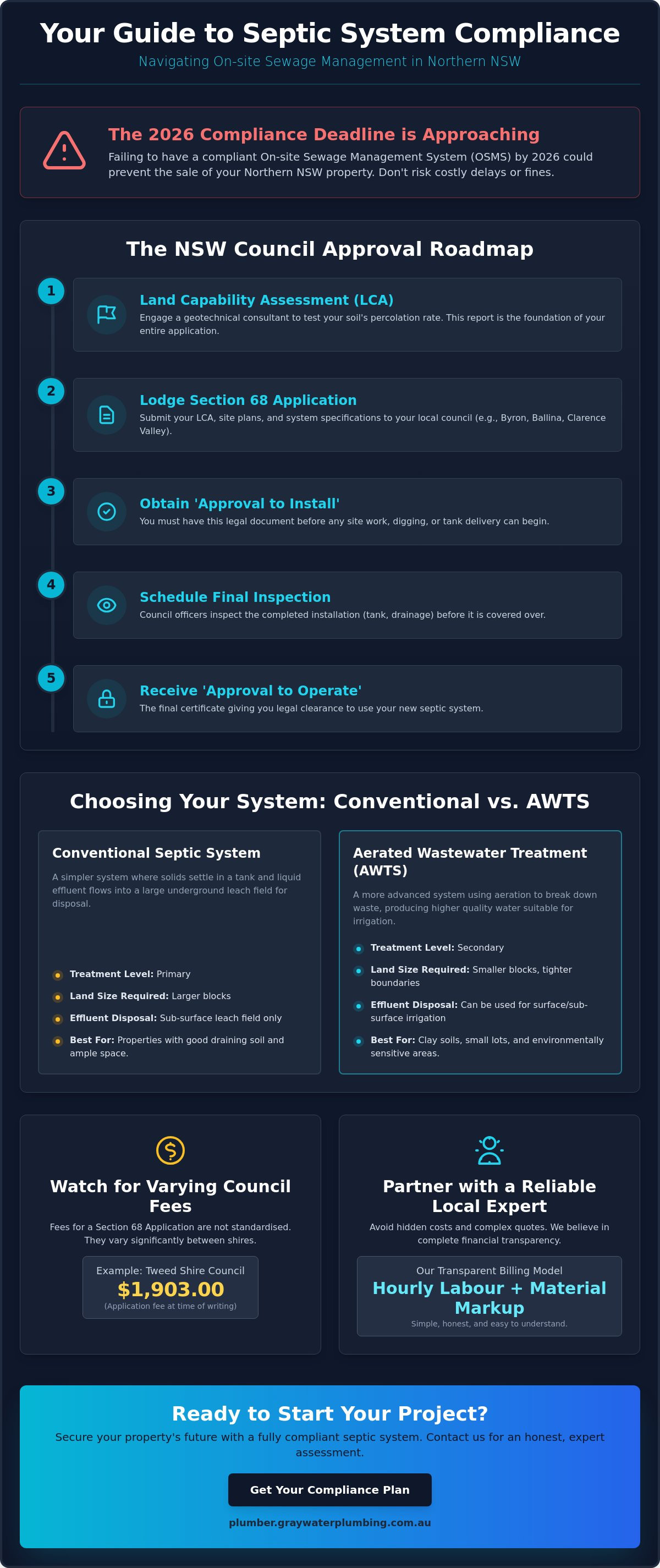
Most homeowners choose between a conventional septic system and an Aerated Wastewater Treatment System (AWTS). Conventional systems provide primary treatment where solids settle in a tank and liquid effluent flows into a leach field. An AWTS is more complex. It uses oxygen to encourage bacteria to break down waste, providing secondary treatment that results in much cleaner effluent. Your land size often dictates this choice. Smaller blocks usually require an AWTS because the treated water is safer to use in irrigation, allowing for smaller "setback" distances from boundaries. We also look at diverting greywater, which is the wastewater from your laundry and showers, to reduce the load on your primary treatment tank.
Why a Site Assessment is Your First Real Step
You cannot simply buy a tank and dig a hole. The very first step in the process of how to get septic approval is a Land Capability Assessment (LCA). A geotechnical engineer or specialised consultant must visit your property to test the soil. They look for "percolation" rates, which is just a technical way of asking how fast water drains through your ground. In the Clarence Valley, we often deal with heavy clay that holds water like a bowl. Local knowledge of these soil patterns is vital. If your soil doesn't drain well, your application will fail unless the system is specifically engineered to compensate. This assessment forms the backbone of your council application and ensures the system you install actually works for your specific patch of dirt.
The Step-by-Step NSW Council Approval Process
Securing local council approval is the most administrative part of the journey. In New South Wales, you cannot simply start digging because you own the land. The process is governed by strict environmental health standards to prevent effluent from entering our local waterways. Understanding the sequence of how to get septic systems approved ensures you don't waste money on unapproved works that council might later order you to remove.
The journey follows a specific chronological order:
- Step 1: Engage a consultant to conduct a Land Capability Assessment (LCA). This report is the foundation of your application.
- Step 2: Lodge a Section 68 Application with your local Council. Whether you are in the Byron Shire or Clarence Valley, this is the legal requirement for all on-site sewage works.
- Step 3: Obtain the 'Approval to Install'. You must have this document in hand before any soil is turned or tanks are delivered to the site.
- Step 4: Schedule a final inspection. Once the physical installation is complete but before the system is covered, Council officers must inspect the drainage and tank placement.
- Step 5: Receive your 'Approval to Operate' certificate. This is your final legal clearance to begin using the system.
Navigating Section 68 of the Local Government Act
Section 68 is the specific legal mechanism for all NSW septic approvals. It is not just a formality; it is a comprehensive review of your property's ability to manage waste. To lodge this, you will need detailed site plans, system specifications from the manufacturer, and your soil reports. Fees vary significantly between regions. For instance, Tweed Shire Council charges $1,903.00 for a new system application in the 2025-2026 period, while Clarence Valley Council sits at $782.08. We often help clients organise the technical plumbing details for these forms to ensure the application is processed without unnecessary delays.
Understanding the Land Capability Assessment (LCA)
An LCA is a mandatory report that proves your land can safely absorb treated wastewater. The 'percolation rate' of your soil is the most critical figure in this document. It determines the exact size of your effluent disposal area. If you have a steep slope or are close to a creek, your disposal area might need to be shifted or the system upgraded to an aerated model. Local flood levels also play a role in where your tank can be safely positioned. Getting this report right the first time is the most effective way to manage the total cost of how to get septic systems installed on difficult blocks.
Choosing the Right Septic System for Your Needs
Selecting a system is a balance between your property's physical constraints and your long-term budget. While the initial price tag is a major factor, the ongoing operational costs often surprise homeowners. When you are looking at how to get septic infrastructure that lasts, you must consider the number of bedrooms in your home. Council regulations dictate tank capacity based on potential occupancy rather than the number of people currently living there. A three-bedroom house typically requires a different treatment capacity than a five-bedroom residence, regardless of whether those rooms are occupied.
The straight-shooting reality is that your choice often comes down to the trade-off between upfront capital and monthly bills. Aerated systems require a constant power supply to run internal blowers and pumps, which will reflect on your quarterly electricity statement. Conversely, a gravity-fed system has almost zero power cost but might require a more expensive, larger disposal area if your soil is poor. We always recommend choosing a system with locally available spare parts. In the Northern Rivers, being able to source a replacement pump or filter from a local supplier in Grafton or Lismore is much better than waiting weeks for a specialised part to arrive from interstate.
Conventional Septic Tanks and Absorption Trenches
A conventional system is the passive choice for wastewater management. It relies on gravity and natural anaerobic bacteria to break down solids within a concrete or poly tank. The liquid effluent then flows into absorption trenches. These systems are popular because they have no moving parts and require very little power. However, they are not suitable for every block. If you have the heavy clay soil common in the Clarence Valley, your land may not absorb the effluent quickly enough. Proper septic tank maintenance is the most critical factor here. Without regular pump-outs, solids can carry over into your trenches, causing them to fail and requiring a complete, costly rebuild of the disposal area.
Aerated Wastewater Treatment Systems (AWTS)
An AWTS is an active treatment plant that uses mechanical aeration to produce high-quality effluent. Because the water is treated to a secondary level, it is much cleaner than what comes out of a standard septic tank. Local councils often mandate an AWTS for smaller blocks or sensitive environments near the Richmond River where traditional trenches might pose a contamination risk. The cleaner water can often be distributed via surface or sub-surface irrigation, which requires less land area. You must factor in the legal requirement for quarterly servicing by a licensed technician. This ensures the mechanical components and disinfection processes are functioning correctly to meet NSW health standards.
Preparing for Installation Day: What to Expect
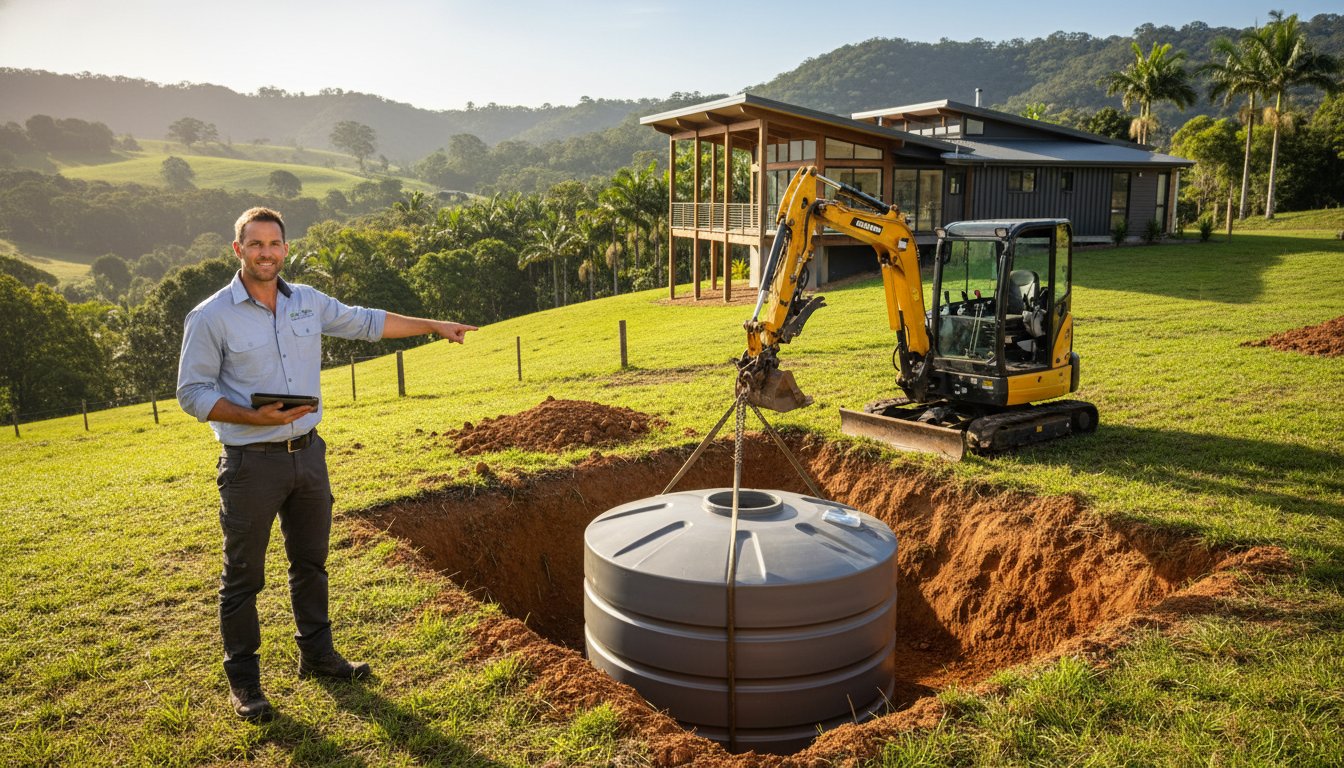
Once you have your 'Approval to Install' from council, the physical phase of the project begins. This is where the administrative process of how to get septic systems transitions into a serious civil works project. Installing a system on a rural block is not a simple plumbing job; it involves heavy machinery, significant earthworks, and precise coordination. You can expect to see large excavators and delivery trucks carrying concrete or poly tanks that often weigh several tonnes. It is a busy period that requires a clear plan to ensure the site remains safe and the installation stays on track.
Rural Northern NSW properties often present unique logistical challenges. Narrow access tracks, low-hanging trees, or soft ground can prevent a crane truck from reaching the designated installation site. We assess these hurdles before the first shovel hits the ground. If the site is particularly difficult to reach, we may need to arrange smaller equipment or specialised transport, which is why we provide a clear breakdown of hourly labour and material costs upfront. Transparency at this stage prevents surprises when the final bill arrives.
Weather is the other major variable in our region. The Northern Rivers wet season can easily stall a project. Heavy rain turns a fresh excavation into a mud pit, making it impossible to level a tank base or lay out irrigation lines correctly. We monitor local conditions closely because digging in saturated soil can lead to compaction. If the soil in your disposal area is compacted by heavy machinery during a wet spell, it will fail to absorb effluent, effectively ruining the work done during your Land Capability Assessment. Your plumber will also handle the coordination for the mandatory 'open trench' inspection, ensuring the council officer can verify the drainage and tank placement before anything is covered up.
Excavation and Tank Placement
Preparing the site is a matter of precision. We ensure the excavation is level and the base is prepared with the correct bedding material, usually sand or specific gravel, to prevent the tank from shifting or cracking. Once the tank is lowered into position, we connect the house drainage to the new inlet. While excavation is an inherently messy process, we maintain a commitment to a clean and organised worksite. We understand that this is your home, not just a construction site, and we work to minimise the impact on your daily life.
Setting Up the Effluent Disposal Area (EDA)
The final step is installing the trenches, irrigation lines, or mounds as per your approved plans. This area is the most sensitive part of the system. It is critical to keep vehicles and heavy livestock off your EDA from the very first day. Soil compaction in this zone will stop the ground from absorbing treated wastewater, leading to ponding and potential system failure. For a deeper look at site-specific setups in our region, see our guide on septic tank installation Clarence Valley. If you want a straight-shooting team to handle your project with total pricing transparency, contact us to discuss your installation.
Reliable Septic Solutions with Graywater Plumbing
Choosing a team that understands the local landscape is just as important as the system itself. We act as the straight-shooting experts for homeowners in Yamba, Grafton, and across the Northern Rivers. The process of how to get septic systems installed can feel like a series of administrative hurdles, from soil tests to final inspections. We simplify this by providing a reliable point of contact who understands the specific requirements of regional councils. Our approach is built on a foundation of professional transparency, which is why we are upfront about our fee structure from the very first conversation.
We operate using a clear hourly labour and material markup model. This means you aren't paying for hidden margins or ambiguous package deals that mask the true cost of the work. You pay for the actual time our skilled tradespeople spend on your site and the documented cost of the materials used. This level of transparency fosters trust and ensures you know exactly where your money is going. We value long-term relationships with our clients and prioritising quality craftsmanship over quick, high-margin jobs is central to our business ethic.
Beyond the initial installation, we focus on maintenance plumbing as a proactive service rather than a reactive fix. A septic system is a significant investment that requires regular attention to function correctly over its lifespan. By scheduling routine checks, you can prevent the need for stressful and expensive emergency repairs later. We look for early signs of wear in pumps or potential blockages in disposal lines before they become major problems. This methodical approach gives you the security of knowing your property's wastewater is managed by a disciplined and capable team.
Expertise in Northern NSW Compliance
We have extensive experience navigating the nuances of the Clarence Valley, Byron, and Ballina Shire Council requirements. Every local government area has its own set of expectations for Section 68 approvals and site management. We bridge the gap between your geotechnical report and the finished installation, ensuring every pipe and tank meets the exact specifications required by law. We don't just install tanks; we manage the technical compliance that keeps your home legal and safe.
Your Next Steps to Getting Septic
If you are ready to start, the best move is to book an initial site consultation. We can assess your property's access, discuss your household's needs, and provide a clear explanation of the work required. For those with existing systems, we also offer 24/7 emergency support to handle blockages or mechanical failures quickly. Contact the Graywater Plumbing team today to start your septic journey with a partner you can trust.
Take Control of Your Property's Wastewater
Managing an on-site sewage system doesn't have to be a source of stress. By following the clear sequence of land assessments and Section 68 applications, you ensure your home remains compliant with NSW regulations. Choosing between a conventional tank and an aerated system is a decision that impacts both your initial budget and your long-term power bills. Getting the right advice early prevents costly mistakes during the excavation phase.
Learning how to get septic systems right involves more than just digging a hole; it requires a partner who understands regional council nuances. Our team of licensed NSW gas fitters and plumbers brings expert knowledge of Clarence Valley Council regulations to every project. We maintain a straight-shooting approach with our transparent hourly labour and material markup pricing, so you always know the exact cost of your installation. We don't believe in hidden fees or ambiguous quotes.
Ready to start your project? Book a Septic Site Consultation with Graywater Plumbing to get your wastewater sorted with confidence. Your property is a major investment, and we're here to help you protect it with a reliable, long-term solution.
Frequently Asked Questions
How much does it cost to get a septic system installed in NSW?
The average cost of a septic system in New South Wales typically ranges from $18,347.88 to $27,521.82. This total includes the cost of the tank, professional installation, and various council fees. Application costs vary between regions; for instance, Tweed Shire Council charges $1,903.00 for a new system application in 2025-2026, while Clarence Valley Council fees are $782.08 for the same period.
Can I install my own septic tank to save on costs?
No, you cannot legally install your own septic system in New South Wales. State legislation requires all on-site sewage management works to be carried out by a licensed plumber to ensure environmental and health standards are met. We provide a straight-shooting approach to these projects by using a transparent hourly labour and material markup pricing model, which ensures you pay a fair price for professional expertise.
How long does the Council approval process for a septic tank take?
The approval process generally takes between 4 and 8 weeks from the time you lodge your application. This timeframe allows council officers to review your Section 68 application and the accompanying Land Capability Assessment. When you are planning how to get septic systems organised for a new property in Byron or Ballina, it is wise to factor in this two-month window to avoid delays in your construction schedule.
What happens if my soil fails the Land Capability Assessment?
If your soil fails the initial assessment, you will likely need to install a more advanced treatment system or an engineered disposal area. Soil with a poor percolation rate, such as the heavy clay found in parts of the Northern Rivers, may require an Aerated Wastewater Treatment System (AWTS) or a raised sand mound. These systems treat effluent to a higher standard, making it safe for the ground to absorb even in difficult conditions.
How often does a new septic system need to be pumped out?
Most septic tanks require a professional pump-out every 3 to 5 years to remove accumulated solids. This frequency depends on the size of your household and your daily water usage. Regular pumping is a core part of proactive maintenance plumbing; it prevents sludge from entering and clogging your absorption trenches, which can lead to system failure and expensive ground restoration works.
Do I need a different type of septic system if I have a large family?
Yes, a larger family requires a system with a higher hydraulic capacity to handle increased wastewater flow. Council determines the required tank size based on the number of bedrooms in your home rather than the current number of occupants. When looking at how to get septic tanks that meet legal requirements, you must ensure the system capacity matches the potential occupancy of the dwelling to prevent overloading.
What is the difference between an 'Approval to Install' and an 'Approval to Operate'?
The 'Approval to Install' is the permit that allows you to begin construction, while the 'Approval to Operate' is the final certificate that allows you to start using the system. You receive the 'Approval to Install' after council approves your plans and soil reports. The 'Approval to Operate' is only issued after a council officer performs a final inspection of the installation to ensure it matches the approved design.
Can I build a deck or driveway over my septic tank?
You must not build any structures, including decks or driveways, over your septic tank or effluent disposal area. The tank must remain accessible for regular inspections and pump-outs by vacuum trucks. Furthermore, the weight of vehicles or buildings can crack the tank or compact the soil in your disposal area, which stops the ground from absorbing wastewater and will eventually cause the system to fail.