Did you know that there are approximately 9,500 on-site wastewater systems spread across the 10,500 square kilometres of our region? Managing a septic tank installation clarence valley project is often more of a regulatory hurdle than a simple plumbing job. We understand that the $782.08 application fee and the technical complexities of a Section 68 submission can feel like a headache before you've even broken ground. You want a system that works, stays compliant with the Local Government (General) Regulation 2021, and doesn't come with hidden financial surprises.
This guide simplifies the process by providing clear, honest advice based on the latest 2025-26 council standards. We'll help you master the local requirements so you can secure a low-maintenance, NSW Health-approved system for your property. We'll walk through the On-site Wastewater Management Strategy 2025, explain why soil suitability is your first priority, and outline the transparent pricing structures you should expect from a professional local installer. By the end of this guide, you'll have a clear path to a reliable, off-grid solution.
Key Takeaways
- Navigate the Section 68 application process with confidence by understanding the mandatory soil testing and Land Capability Assessment requirements for our region.
- Compare conventional septic tanks against Aerated Wastewater Treatment Systems (AWTS) to determine which technology suits your property's specific environmental sensitivity.
- Prepare for your septic tank installation clarence valley by reviewing the standard 5-7 day timeline and the heavy machinery needed for site excavation.
- Secure a fairer deal with our transparent "Hourly Labour and Material Markup" fee structure that eliminates the guesswork and hidden costs of fixed-price rural quotes.
- Identify your ongoing maintenance obligations under the 2025-26 council strategy to ensure your wastewater system remains efficient, safe, and compliant for years to come.
Understanding Septic Tank Installation in the Clarence Valley
On-site Sewage Management Systems (OSMS) are a necessity for the approximately 9,500 properties in our region that operate independently of the town sewer. In a Local Government Area covering 10,500 square kilometres, extending central infrastructure to every hinterland block isn't feasible. This means rural homeowners are responsible for their own wastewater treatment. A standard system manages two types of waste: "blackwater" from toilets and "greywater" from showers, sinks, and laundries. To get started, it helps to understand how septic systems work at a fundamental level before diving into our specific local council requirements.
Getting your septic tank installation clarence valley project right is about more than just convenience. It's a critical environmental safeguard. Incorrectly installed systems can leak nutrients and pathogens into the Clarence River catchment, damaging the local ecosystem and risking public health. Because our region relies heavily on its natural waterways, the Clarence Valley Council maintains strict oversight through the Local Government Act 1993 and the Local Government (General) Regulation 2021. We take a methodical approach to these installations to ensure every component meets NSW Health standards and protects your property's value.
Why Local Expertise Matters in Northern NSW
The Northern Rivers region presents a unique set of geographic challenges. Soil profiles vary significantly between the heavy, reactive clays often found around Grafton and the sandy, high-water-table environments near Yamba. High annual rainfall in our area also places immense pressure on drainage fields. If a system isn't designed for these specific conditions, it will likely fail during the first major wet season. For those starting a fresh build, it's vital to work with a licensed new home plumbing specialist who understands regional compliance and terrain. We don't guess; we assess the land to ensure your drainage remains functional even in the heaviest downpours.
The Role of the Onsite Wastewater Management Plan
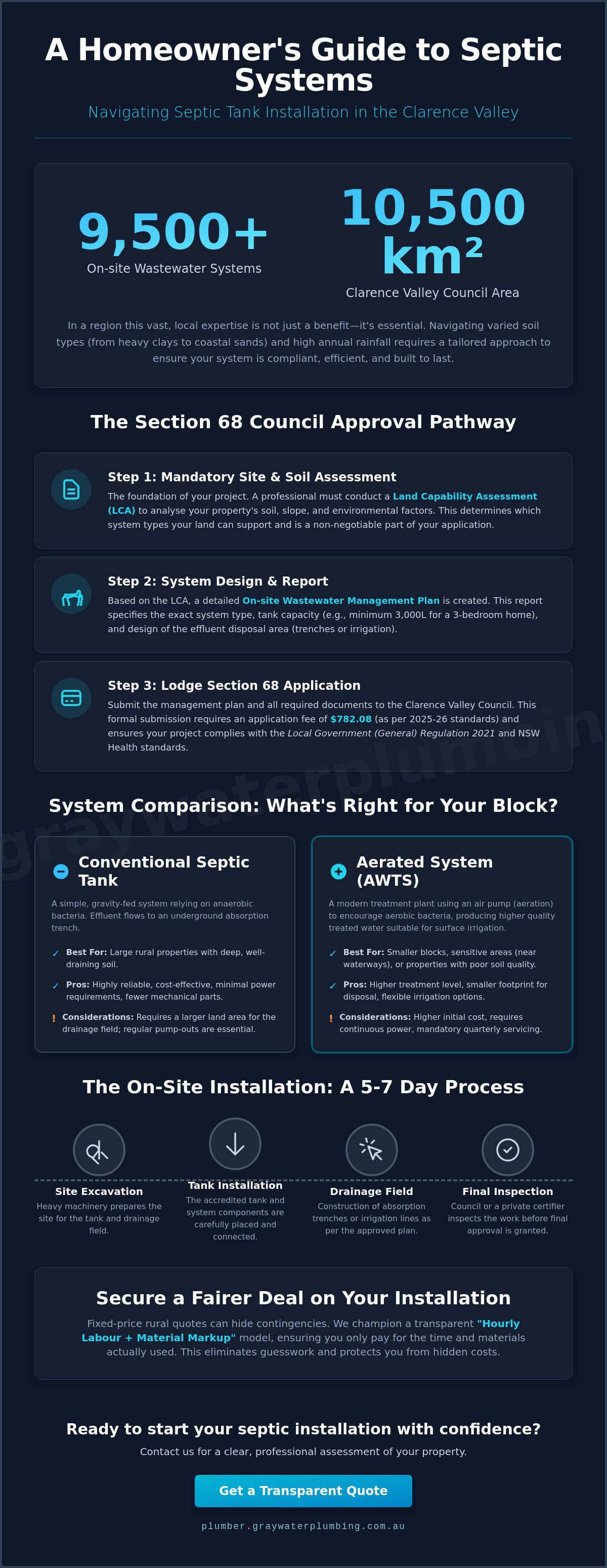
A professional site assessment is the foundation of any successful installation. This plan is a mandatory part of your Section 68 application and dictates exactly what type of system your block can support. It considers the number of bedrooms in your home, the slope of the land, and the "loading" the soil can handle. A "one size fits all" approach is a recipe for disaster. If a tank is too small for the household or the absorption area is undersized for the soil type, you'll face odours, boggy patches, and expensive repairs. We prioritise a disciplined, systematic assessment to ensure your system is a long-term asset rather than a constant maintenance burden.
Choosing the Right Septic System for Your Property
Selecting the correct hardware for your septic tank installation clarence valley project is a decision that impacts your property for decades. All systems installed in NSW must carry valid NSW Health accreditation to ensure they meet strict safety and performance standards. The choice between a conventional system and a modern treatment plant usually depends on your land's size, soil type, and proximity to watercourses. We focus on providing a clear assessment of these options so you can avoid the stress of a system that doesn't suit your lifestyle or your block.
Capacity is another critical factor that homeowners often overlook. A standard three-bedroom home typically requires a tank with a minimum capacity of 3,000 litres to allow for adequate settling time. If your household is larger or you plan to host frequent guests, increasing this capacity is a proactive measure that prevents the system from becoming overwhelmed. We also need to consider how the treated water is dispersed. You'll generally choose between absorption trenches, which sit underground, or irrigation fields, which can distribute treated water across your lawn or garden beds depending on the level of treatment achieved.
Conventional Septic Systems: Simple and Reliable
Conventional systems are often the most cost-effective choice for large rural properties with deep, well-draining soil. These systems rely on a gravity-fed process where solids settle in a primary tank and anaerobic bacteria break down the waste. Because they don't require air pumps or complex electronics, they have very low power requirements and fewer mechanical parts to fail. They are a "set and forget" style of technology, provided you maintain a regular pump-out schedule to prevent sludge build-up from entering your absorption trenches.
Aerated Wastewater Treatment Systems (AWTS): The Modern Choice
An AWTS functions like a miniature sewage treatment plant on your property. It uses an oxygenation process to support aerobic bacteria, followed by a disinfection stage using chlorine or UV light. This produces a higher quality of effluent, which is why they are frequently required for Clarence Valley Council approvals on smaller blocks or near sensitive environmental zones. While highly efficient, these systems do require a permanent power connection and mandatory quarterly septic tank maintenance by an authorised service agent. If you are looking for a long-term partner to manage these complexities, our team can help you organise a compliant service plan that keeps your system running perfectly.
Navigating Clarence Valley Council Approvals and Soil Requirements
Obtaining Council approval is often the most stressful part of the process for homeowners. In our region, you must submit a Section 68 application through the NSW Planning Portal before any work begins. This application currently incurs a fee of $782.08 for the 2025-26 period. It's a detailed process that ensures your septic tank installation clarence valley project complies with the Local Government Act 1993 and the Local Government (General) Regulation 2021. We handle the technical coordination of this submission to ensure your project doesn't get bogged down in administrative delays.
A common mistake is assuming you can install the same system as your neighbour. Soil conditions can change significantly within just a few metres, even on the same street. This is why a Land Capability Assessment (LCA) is non-negotiable. The LCA involves professional soil testing to determine how well your land can safely absorb treated effluent. You must also adhere to strict setback distances. For example, systems must typically be situated at least 40 metres away from permanent watercourses and maintain specific clearances from property boundaries and buildings to prevent cross-contamination.
To submit a successful application, you'll need to gather a specific set of documents. We recommend having these ready to avoid multiple requests for information from Council officers:
- A detailed site plan showing the proposed tank location and the exact dispersal area.
- The professional Land Capability Assessment report.
- Hardware specifications proving NSW Health accreditation for the chosen tank.
- A floor plan of the dwelling to confirm the number of bedrooms and potential wastewater load.
Soil Testing: The Foundation of Your System
The "perc test" or percolation test measures the rate at which water moves through your soil. If your property has heavy clay, water stays on the surface too long, leading to boggy patches and odours. If the soil is too sandy, effluent might drain too quickly before the soil bacteria can properly treat it. In areas with poor drainage or high environmental sensitivity, we might need to design a "raised mound" system. This provides an engineered layer of sand and soil to filter the waste before it reaches the natural ground level.
Council Inspection Milestones
Council officers don't just check the finished product; they require inspections at critical stages of the build. They typically need to see the open trenches and the tank placement before any soil is backfilled. Once the installation is finalised and meets the required standards, you'll receive an "Approval to Operate." This permit is subject to an annual $50.00 charge for occupied properties. We take responsibility for organising these inspection windows so you don't have to manage the back-and-forth with Council staff.
The Installation Process: What to Expect On-Site
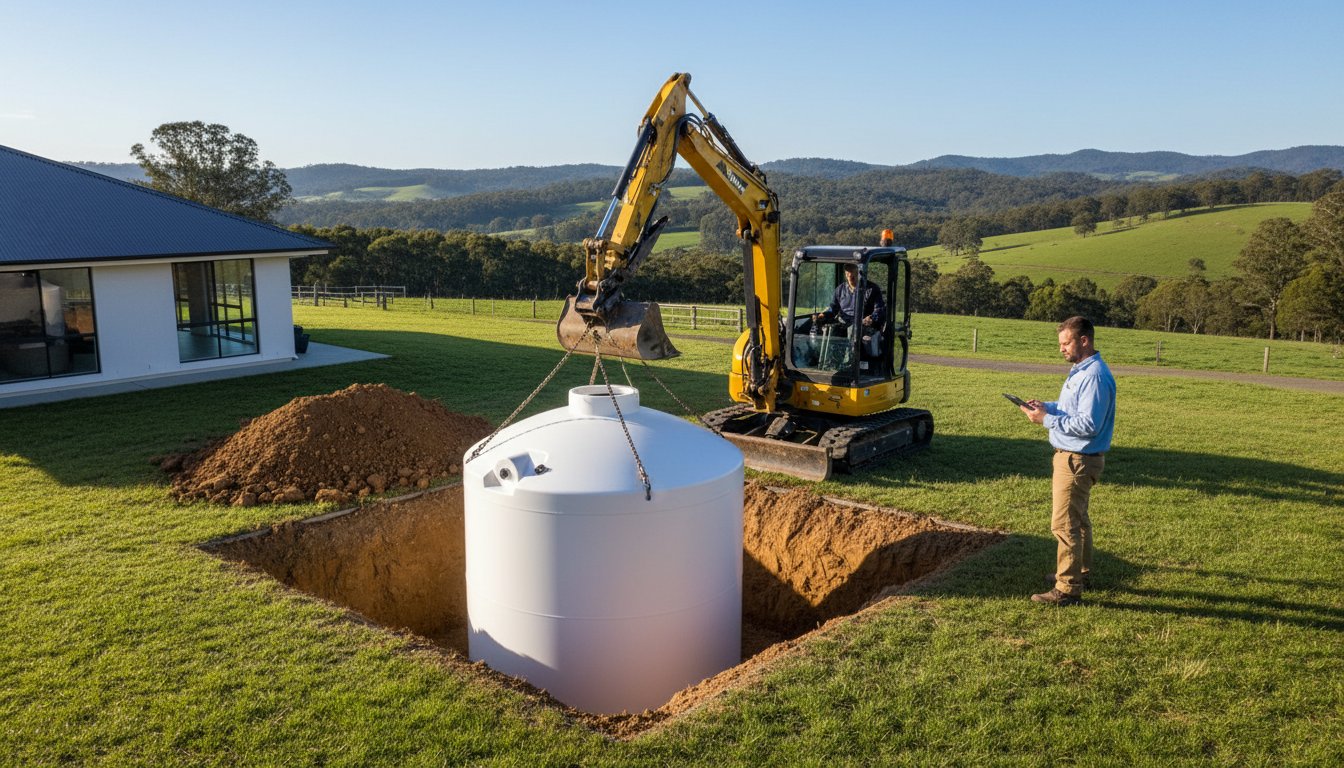
A typical septic tank installation clarence valley project follows a disciplined 5-7 day timeline. This structured approach ensures every component, from the primary tank to the final irrigation line, is installed to withstand the Northern Rivers' variable weather. We coordinate the arrival of heavy machinery, usually a 5-tonne or 8-tonne excavator, to handle the bulk of the earthmoving. Our priority during this time is maintaining a safe worksite and ensuring the plumbing levels are precise. If the fall on the drainage pipes is even slightly off, the system will face blockages or back-ups within months.
Once the hardware is in the ground, the final stages involve commissioning the system and site remediation. We don't just bury the tank and leave. We test the flow, check for leaks at every junction, and ensure the backfilling is compacted correctly to prevent future subsidence. Our goal is to leave your property in a stable condition, with the system fully operational and ready for its first Council inspection. This methodical process is why we prioritise quality craftsmanship over rushing to the next job.
Step 1: Site Preparation and Excavation
We begin by marking out the exact footprint of the tank and dispersal area as dictated by your approved site plan. Protecting your existing landscaping is a key concern, so we establish clear access paths for the machinery to minimise soil compaction. Excavation depth varies depending on the tank model, but most concrete or plastic tanks require a hole approximately 2 to 3 metres deep. We implement strict safety protocols, including temporary fencing around open excavations, to protect residents and livestock while the work is in progress.
Step 2: Tank Placement and Pipe Connection
Once the hole is ready, we prepare a level sand bedding to provide a stable foundation for the tank. This prevents the unit from shifting or cracking over time. After the tank is lowered into position, we connect the main house drain to the inlet using high-quality PVC fittings. We pay close attention to the "fall" or slope of these pipes; a standard 1:60 ratio is usually required to ensure waste moves efficiently from the house to the tank. We then install the outlet pipe that leads to your specific dispersal area.
Step 3: Dispersal Area Construction
The final phase involves building the dispersal system. For traditional systems, this means laying out absorption trenches filled with aggregate and wrapped in geo-fabric to prevent soil from clogging the pipes. If you've opted for an AWTS, we install the irrigation lines and the mandatory alarm panel. This panel is usually located near the house to alert you if the pump or aerator requires attention. Once everything is connected, we conduct a final commissioning test before backfilling. If you're ready to start your build, you can book a site consultation with our team today.
Transparent Pricing and Expert Workmanship: The Graywater Difference
Choosing a partner for your septic tank installation clarence valley project often comes down to trust. We believe trust is built through radical transparency, especially regarding how we bill for our services. Unlike many contractors who provide a "fixed" quote with hidden contingencies, we operate on an Hourly Labour and Material Markup model. This approach ensures you only pay for the actual work performed on your property. We maintain an organised, clean worksite throughout the build, ensuring our presence on your Northern NSW property is as non-disruptive as possible. Our team arrives on time, works efficiently, and clears away debris daily to keep your home life running smoothly.
Rural installations are rarely straightforward. You might encounter unexpected rock during excavation or require additional drainage pipework due to a specific soil pocket discovered on-site. Fixed-price quotes usually include a heavy financial buffer to cover these risks, which means you often pay for "worst-case" scenarios even if they don't happen. With our model, if the job is straightforward, you save money. If complications arise, you see exactly where the extra time and materials are going. We also provide 24/7 support for any post-installation queries or emergencies. If you have a question about your alarm panel or a concern after a heavy storm, we're just a phone call away.
Why Radical Transparency Benefits You
Our billing structure is designed to be fair and easy to digest. You pay a set hourly rate for our skilled labour and a standard, industry-consistent markup on the materials we use. This eliminates the "quote anxiety" that many homeowners feel when starting a large infrastructure project. By disclosing our costs upfront, we position ourselves as a dependable partner rather than just another service provider. We take pride in our ethical approach; we value long-term relationships with our local community over one-off, high-margin jobs. You'll receive a detailed breakdown of every pipe, fitting, and hour spent, ensuring there are no hidden surprises when the final invoice arrives.
Local Knowledge, Local Results
Our team has spent years building professional relationships with Clarence Valley Council inspectors. We know exactly what they look for during those critical inspection milestones. This local knowledge helps prevent unnecessary delays or the $205.80 re-inspection fee that applies if a system doesn't meet standards the first time. Beyond the initial installation, we focus on maintenance plumbing. We treat your wastewater system as a proactive asset that needs regular care, not just a reactive fix when something goes wrong. This preventative mindset ensures your system remains compliant with the On-site Wastewater Management Strategy 2025 for its entire lifespan. If you're looking for a straightforward, no-nonsense approach to your wastewater needs, we're ready to help. Contact Graywater Plumbing for a straight-shooting quote today.
Securing Your Property's Wastewater Future
Building a home in the Northern Rivers requires a disciplined approach to wastewater management. You now understand that a successful septic tank installation clarence valley depends on accurate soil testing and navigating the Section 68 application process. Whether you choose a simple conventional tank or a modern AWTS, your system must meet the standards set by the On-site Wastewater Management Strategy 2025 to protect our local waterways and maintain your property's compliance.
We are Licensed NSW Drainers and Gasfitters who specialise in Clarence Valley Council compliant systems. Our no-nonsense Hourly Labour and Material Markup billing ensures you receive a fair price without the hidden margins common in fixed quotes. We take pride in delivering methodical, high-quality workmanship that stands up to our regional climate. If you're ready to move forward with a reliable off-grid solution, we're here to help you get the job done right. Request a Transparent Quote for Your Septic Installation and let's discuss your property's specific needs. Your new wastewater system is a long-term investment in your home's value and the health of our local environment.
Frequently Asked Questions
How much does septic tank installation cost in the Clarence Valley?
Installation costs generally range from $3,000 to $20,000 depending on the system type and site conditions. Traditional septic setups occupy the lower end of the scale, while advanced aerobic systems typically cost between $10,000 and $20,000. These figures include hardware and labour but exclude the mandatory $782.08 council application fee for the 2025-26 period. Complex sites with rocky terrain or poor drainage will naturally sit at the higher end of these estimates.
How long does it take for Clarence Valley Council to approve a septic system?
Homeowners should generally allow four to six weeks for the Clarence Valley Council to process a Section 68 application. This timeline depends on the completeness of your documentation, including the Land Capability Assessment and detailed site plans. If the council requires additional information through the NSW Planning Portal, the process can take longer. We coordinate closely with local inspectors to ensure your application moves through the system as efficiently as possible.
Can I install my own septic tank if I am a handy homeowner?
No, you cannot install your own system because all plumbing and drainage work in NSW must be performed by a licensed professional. The Local Government Act 1993 requires that a qualified plumber carries out the installation to ensure it meets strict health and safety standards. Attempting a DIY installation will lead to a failed council inspection and potential fines. It also voids hardware warranties and risks significant environmental contamination on your property.
What is the difference between a septic tank and an AWTS?
A traditional septic tank uses anaerobic bacteria for basic waste treatment, while an Aerated Wastewater Treatment System (AWTS) uses oxygen and disinfection stages to produce higher-quality effluent. An AWTS is often mandatory for smaller blocks or areas with high environmental sensitivity. While they require quarterly servicing and a constant power connection, they allow for more flexible irrigation options. Traditional septic systems are simpler but require larger land areas for absorption trenches.
How often do I need to pump out my septic tank in Northern NSW?
You should generally pump out your septic tank every three to five years to prevent sludge build-up from entering your dispersal area. In the Northern Rivers, high usage or a larger household might require more frequent maintenance to protect your absorption trenches from clogging. Regular desludging is a core responsibility for the 9,500 system owners in our region. Neglecting this task eventually leads to system failure and expensive remediation costs that far exceed the price of a pump-out.
What are the setback requirements for a septic system in NSW?
Standard NSW setback requirements usually require systems to be at least 40 metres from permanent watercourses and 100 metres from shared water catchments. Your dispersal area must also stay at least 6 metres from any buildings and 3 metres from property boundaries. These distances are designed to prevent effluent from entering waterways or affecting neighbouring land. Your specific Land Capability Assessment will confirm the exact setbacks required for your block's unique topography and soil type.
What happens if my soil fails the Land Capability Assessment?
If your soil fails the initial assessment, you will need to adopt an alternative dispersal method rather than a standard absorption trench. This often involves a septic tank installation clarence valley that utilises an AWTS with irrigation or an engineered "raised mound" system. These solutions use imported sand and soil to provide the filtration that your natural ground cannot offer. While these options involve higher initial costs, they ensure your property remains compliant and environmentally safe.