Imagine it is 7:00 PM on a Saturday in Byron Bay, your restaurant is at capacity, and a foul odour begins to drift through the dining room because of a backed-up drain. It is a scenario that can lead to immediate closure and potential fines from the Byron Shire Council that often exceed A$2,000 for non-compliance with liquid waste regulations. You likely already realise that managing trade waste is a demanding part of running a commercial kitchen, and the stress of hidden contract fees or sudden blockages during peak service is the last thing your team needs.
Our professional grease trap cleaning services are designed to remove that burden through a straightforward, transparent approach. We ensure your business remains fully compliant with both Byron and Ballina Shire Council standards, providing you with the necessary documentation and predictable maintenance intervals. By focusing on proactive care rather than reactive fixes, we help you avoid the chaos of emergency plumbing calls and the sting of unexpected costs. This article outlines how our expert liquid waste management keeps your kitchen functional, your drainage clear, and your overheads manageable across the Northern Rivers.
Key Takeaways
- Understand how Byron Shire and Ballina Shire Council trade waste policies dictate your kitchen's specific compliance category and required cleaning frequency.
- Discover why professional grease trap cleaning services involve more than just a pump-out, including high-vacuum extraction and thorough system assessments.
- Learn to identify early warning signs like baffle failure or root intrusion to avoid the high costs of emergency call-outs and kitchen shutdowns.
- See how proactive maintenance and a transparent "hourly labour and material markup" fee structure provide financial certainty for your business.
- Ensure your liquid waste management remains fully compliant with Northern Rivers regulations while keeping your commercial kitchen odour-free.
What are Grease Trap Cleaning Services and Why are They Vital for Northern NSW Businesses?
For restaurant owners in Byron Bay and Ballina, a grease trap, also known as a grease arrestor, is the primary defence for our local sewer systems. These systems are designed to intercept fats, oils, and grease (FOG) before they enter the public wastewater network. To understand the basics, you can read more about What is a grease trap? and its role in commercial plumbing. In the Northern Rivers, where our infrastructure faces unique environmental pressures, these units prevent the formation of "fatbergs." These are massive, solid blockages formed when grease congeals around non-biodegradable items, which can lead to sewage overflows into our pristine local waterways.
Local councils, including Byron Shire and Ballina Shire, mandate regular maintenance for all food premises. This isn't just a suggestion. It's a requirement to protect the 220 kilometres of sewer mains in the Byron region. Many business owners mistake a simple liquid pump-out for a full service. Professional grease trap cleaning services involve more than just removing the top layer of water. It requires a comprehensive scrape of the internal walls and a thorough inspection of the unit's integrity to ensure the system functions at peak efficiency.
The Mechanics of a Commercial Grease Arrestor
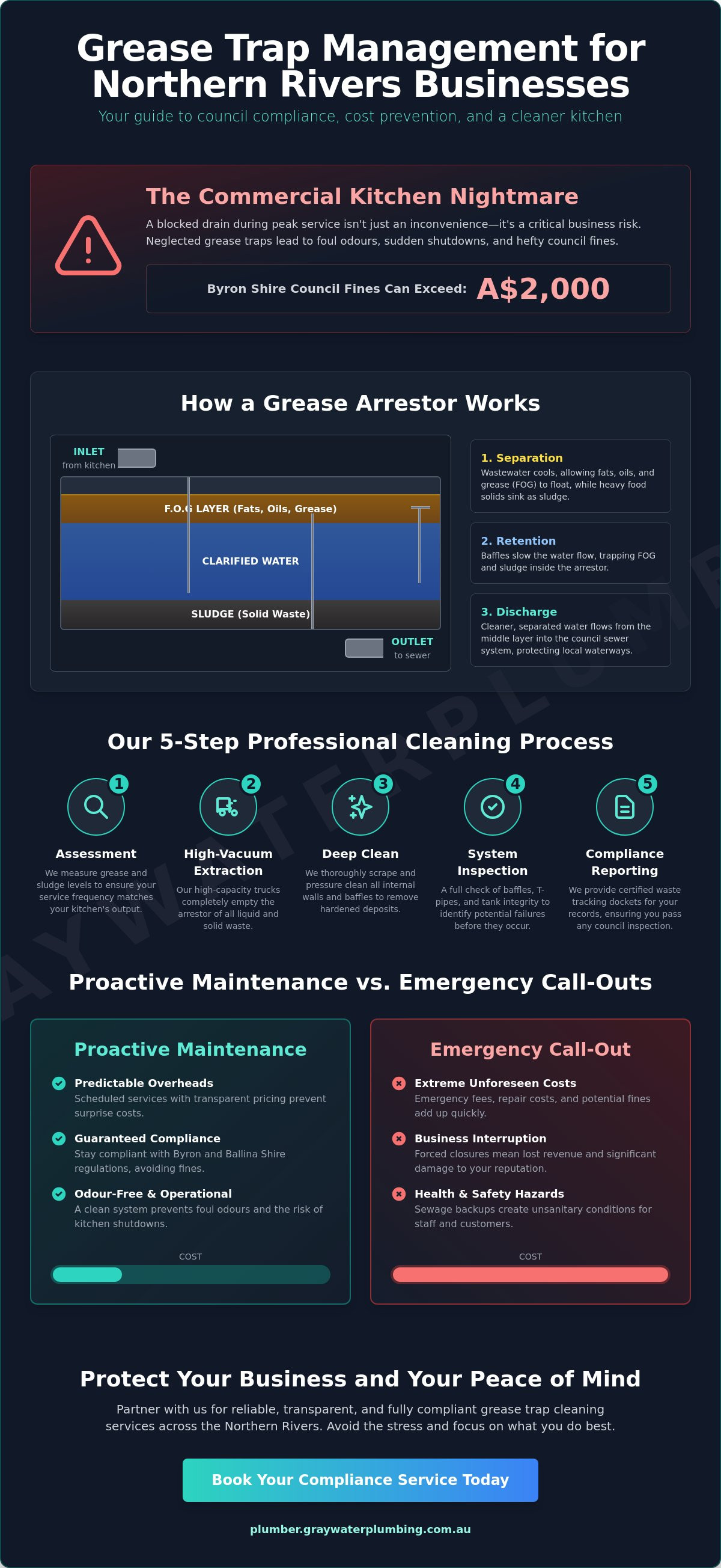
A grease arrestor works on the principle of gravity and cooling. As warm, greasy wastewater enters the tank, a series of internal baffles slows the flow. This allows the mixture to cool and separate into three distinct layers. The heavy solids sink to the bottom as sludge, while the lighter fats and oils float to the top to form a thick crust. The clarified water sits in the middle, ready to exit through the outlet T-pipe.
It's vital to remove the crust and sludge layers entirely during a service. If the sludge builds up too high or the crust becomes too thick, the "retention time" of the water decreases. This leads to grease escaping through the T-pipe and into the council mains. We've seen cases where neglected T-pipes have snapped or become blocked, causing immediate kitchen backups and costly emergency repairs.
Legal Obligations for Food Businesses in the Northern Rivers
Operating a commercial kitchen in New South Wales means complying with the NSW Liquid Trade Waste Regulation 2005. Under this framework, businesses must have a formal agreement with the local water authority to discharge waste. Failure to maintain your grease trap can lead to heavy fines, health orders, or even the suspension of your trade waste permit. Byron Shire Council inspectors frequently conduct audits to ensure businesses adhere to their specific pump-out schedules, which are typically set at 13-week intervals for most cafes and restaurants.
Compliance is tracked through a rigorous paper trail. Every time your system is serviced, you must receive a certified waste tracking docket. These documents prove that the waste was transported by a licensed contractor and disposed of at an EPA-approved facility. Keeping these records on-site is essential, as council officers will request them during routine inspections to verify your grease trap cleaning services are up to date. This transparency protects your business from liability and ensures we all do our part to keep the Northern Rivers environment clean.
The Step-by-Step Grease Trap Pump-Out and Cleaning Process
Professional grease trap maintenance is a systematic procedure that ensures your Byron Bay kitchen stays compliant with local trade waste requirements. Our team follows a disciplined approach to ensure every litre of waste is managed correctly. The process begins with an initial assessment of the trap’s condition. We measure grease levels to determine if your current cleaning schedule matches your kitchen's actual output. This data-driven approach helps prevent overflows between scheduled visits, especially during peak holiday seasons when kitchen volume can increase by 50% or more.
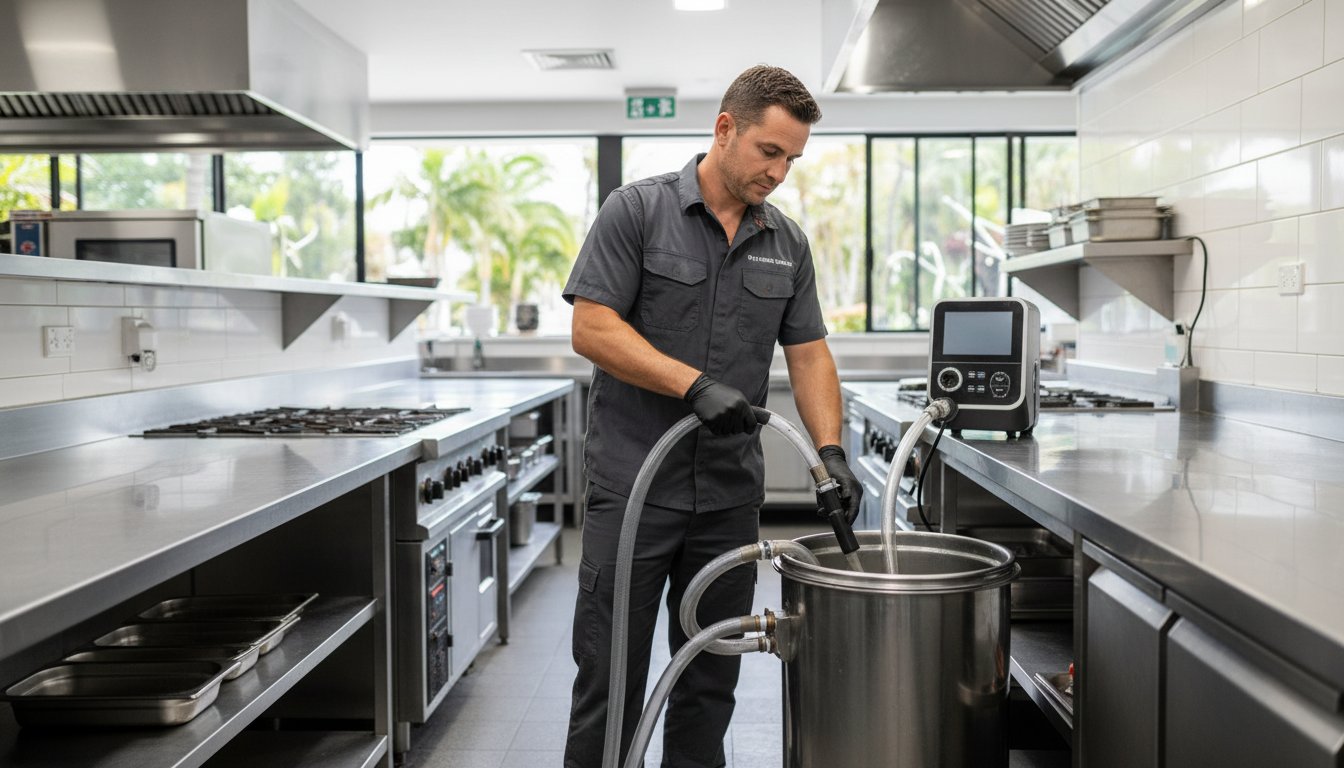
The core of the service involves high-vacuum extraction. We use high-capacity vacuum trucks to remove all liquid and solid waste from the tank. Once emptied, we perform a deep clean. This involves scraping and pressure cleaning the internal walls and baffles. Removing these hardened deposits is essential; left alone, they can reduce the tank's effective volume by up to 20% over time. We also inspect the inlet and outlet pipes for potential blockages. To finish, we deodorise the unit and refill it with clean water. This step is vital because it resets the trap for immediate use, allowing your kitchen to resume operations without delay.
Preparation and Site Safety
Disrupting a busy breakfast or lunch rush in Byron Bay is never an option. We organise our grease trap cleaning services during off-peak hours to keep your business running smoothly. Our technicians set up the vacuum truck and hoses using specific containment protocols to ensure a mess-free extraction. We pay close attention to odour management. By using sealed connections and neutralising agents, we protect your cafe’s atmosphere and ensure your customers remain comfortable throughout the process.
Post-Cleaning Inspection and Plumbing Audit
A clean tank provides the perfect opportunity for a structural health check. We test the baffle integrity and check for any cracks in the tank walls that could lead to ground contamination. It's a standard part of our maintenance plumbing approach to ensure the gas-tight seal on the lid is replaced correctly. This prevents sewer gases from entering your kitchen workspace. We also verify the flow rate against the original design specifications. If you need a reliable partner to manage your compliance, you can request a site audit from our local experts. We focus on transparency, providing a clear report on your system's status after every visit.
Meeting Northern Rivers Trade Waste Requirements and Compliance
Operating a commercial kitchen in the Northern Rivers involves more than just great food; it requires strict adherence to local trade waste regulations. Byron Shire Council and Ballina Shire Council both operate under the NSW Liquid Trade Waste Regulation guidelines, yet they maintain distinct local policies. These rules exist to protect the local sewerage infrastructure from blockages and to prevent environmental contamination in our sensitive coastal ecosystems. We help you stay compliant by ensuring your grease trap cleaning services align with these specific council mandates.
Your business is assigned a risk category, typically Category 1, 2, or 3. Most standard restaurants and cafes fall into Category 2. This classification is the primary factor that determines your mandatory pump-out frequency. Failing to meet these schedules can result in heavy fines or the suspension of your trade waste agreement. Graywater Plumbing provides the technical expertise to interpret these requirements, ensuring your kitchen stays operational without the threat of council intervention.
Local Council Cleaning Schedules
Cleaning frequencies are not a suggestion; they are a condition of your trade waste permit. Standard cycles usually sit between 4 and 13 weeks. Several variables influence this timing, including your seating capacity, the type of menu you serve, and the physical size of your trap. A high-volume burger bar with a small 1,000-litre tank will require a 4-week cycle to prevent overflow. Conversely, a smaller cafe with a 2,000-litre tank might only need a 13-week service.
If you believe your trap is oversized for your current output, you can apply for a variation in cleaning frequency. This process requires a formal submission to your local council. You generally need to provide evidence from three consecutive clean-outs showing that the grease and solids accumulation was well below the 25% threshold. We assist in gathering this data to help you potentially reduce your ongoing maintenance costs through official channels.
EPA Tracking and Responsible Disposal
The journey of your kitchen waste doesn't end when the truck leaves your property. The NSW Environment Protection Authority (EPA) strictly monitors the transport of liquid waste. All grease trap waste must be transported by EPA-licensed operators in certified vehicles. This waste is then tracked from your kitchen to a licensed treatment facility where it is processed safely. Attempting "backyard" disposal or using an unlicensed contractor is a massive risk to your business licence and the local environment.
Graywater Plumbing manages the entire compliance trail for you. We handle the paperwork and provide the necessary dockets that prove your waste was disposed of legally. These dockets are your primary defence during a council audit. Our team uses a methodical approach to ensure every pump-out is logged correctly, maintaining your reputation as a responsible local business while protecting the Northern Rivers waterways.
Preventing Kitchen Shutdowns: Maintenance vs Emergency Call-outs
Reactive plumbing is a gamble that rarely pays off for Byron Bay hospitality venues. When a kitchen stops because of a grease-related blockage, the immediate cost isn't just the plumber's invoice. It's the lost revenue from cancelled bookings and the potential for food spoilage. Scheduling regular grease trap cleaning services allows our team to spot structural issues like baffle failure or root intrusion before they cause a total system failure. These problems often remain hidden until a backup occurs, turning a simple repair into a multi-day closure.
The financial difference between a scheduled visit and a crisis is stark. An emergency call-out on a Saturday night in Byron Bay can cost triple the rate of a standard weekday service. Most commercial plumbers in New South Wales charge a premium for 24/7 attendance, often starting with a high flag-fall fee before any work begins. A scheduled maintenance plan ensures you pay our standard hourly labour rates. This transparent approach provides a much lower total cost of ownership for your plumbing assets and avoids the "emergency tax" associated with after-hours repairs.
Hygiene ratings are also at risk. Under the NSW Food Authority's guidelines, an active grease overflow in a food preparation area is a critical breach. This can result in an immediate Penalty Notice, which carries fines of A$880 for individuals or A$4,400 for corporations. Maintaining your trap isn't just about plumbing; it's about protecting your brand's reputation and your local Council health score.
Identifying the Warning Signs of a Failing Grease Trap
Drains rarely fail without warning. You can avoid a kitchen shutdown by looking for these specific indicators:
- Slow-draining sinks: If floor wastes or pot sinks take longer than usual to clear, grease is likely constricting the pipe diameter.
- Persistent odours: A "rotten egg" or sour grease smell near the trap suggests the water seal is broken or the waste has become septic.
- Downstream bypass: Visible grease or oil in the manholes further down the line indicates the trap is no longer separating waste effectively.
Proactive Plumbing: Beyond the Pump-Out
Effective maintenance involves more than just sucking out the tank. We use high-pressure water jetting to clear the lines between the kitchen and the arrestor, removing hardened fat deposits that a vacuum truck cannot reach. We also inspect the ventilation of the grease arrestor. Proper airflow prevents the buildup of corrosive gases that eat away at concrete and metal components over time. Checking these elements during grease trap cleaning services extends the life of your infrastructure significantly.
In 2026, preventative maintenance for commercial plumbing is defined as the systematic inspection and servicing of drainage assets to ensure 100% operational uptime and regulatory compliance without the need for emergency intervention.
If your drains are slowing down or you haven't had an inspection recently, contact us for professional grease trap maintenance to avoid an expensive emergency shutdown.
Why Graywater Plumbing is the Trusted Choice for Northern NSW Kitchens
Choosing a partner for your grease trap cleaning services requires more than just a quick fix; it demands a relationship built on technical competence and local accountability. At Graywater Plumbing, we operate as straight-shooting local experts. We don't believe in jargon or high-pressure sales. Our team focuses on delivering high-quality maintenance plumbing that keeps your kitchen compliant with council regulations while protecting the local environment.
Our experience extends beyond standard commercial kitchens. We've managed complex civil plumbing projects and local government contracts in Grafton and Yamba. This background in large-scale infrastructure means we understand the rigorous standards required for wastewater management. For our contracted commercial maintenance partners, we provide 24/7 emergency support. If a backup occurs at 9:00 pm on a busy Saturday night, our team is ready to respond, ensuring your doors stay open and your reputation remains intact.
Transparent Pricing and Honest Service
We've built our reputation on a radical approach to billing: the Hourly Labour and Material Markup model. Many providers use ambiguous flat-rate contracts that often hide service gaps or include "buffer" costs that you shouldn't have to pay. Our transparent model ensures you only pay for the actual time spent on-site and the materials used. This fair billing structure has saved Northern Rivers hospitality businesses an average of 15% on annual maintenance costs compared to rigid fixed-price agreements. We prioritise precision workmanship and keep your worksite organised, so your staff can focus on service without navigating a mess.
Your Local Partner in Yamba, Ballina, and Byron Bay
Operating across the Northern Rivers means we have a deep understanding of regional plumbing codes and the specific coastal environmental factors that affect drainage systems. From the salt air in Byron Bay to the high-demand periods in Ballina, we know the local landscape. By choosing a regional expert, you're supporting the local economy and ensuring accountability. We aren't a faceless national franchise; we're your neighbours who take pride in the quality of our craftsmanship. If you're ready for a more reliable approach to wastewater management, organise your next grease trap service with Graywater Plumbing today.
Secure Your Kitchen’s Compliance and Continuity
Managing liquid waste shouldn't be a source of stress for your hospitality business. By staying ahead of scheduled maintenance, you avoid the high costs of emergency repairs and potential fines from local authorities. Our team operates as fully licensed EPA liquid waste transporters with specific expertise in Byron, Ballina, and Clarence Valley council regulations. This local knowledge ensures your trade waste records remain up to date and fully compliant with Northern Rivers standards. We focus on practical solutions that prevent kitchen shutdowns before they ever happen.
Choosing Graywater Plumbing means you receive a straightforward service based on our transparent hourly labour and material markup pricing. We provide professional grease trap cleaning services that keep your drains clear and your kitchen running without interruption. You'll know exactly what you're paying for, with no hidden fees or industry jargon. It's about providing a reliable service that lets you focus on your customers while we handle the compliance. We're here to help your Northern NSW business stay efficient and compliant.
Book a compliant grease trap service for your Northern NSW business to ensure your facility meets every regulatory requirement today. We look forward to keeping your business running smoothly.
Frequently Asked Questions
How often does the Byron Shire Council require grease trap cleaning?
Byron Shire Council generally requires pump-outs every 13 weeks for most food businesses. This 3-month interval ensures that the local sewerage system doesn't get clogged with fats, oils, and grease. Your specific trade waste permit will outline the exact frequency based on your kitchen's volume and equipment. We'll help you stay compliant with these local regulations to avoid fines or permit cancellations, providing a reliable schedule for your peace of mind.
Can I clean my own grease trap to save on commercial service costs?
You can't legally clean a commercial grease trap yourself in Byron Bay. NSW EPA regulations and local council bylaws require a licensed liquid waste transporter to perform the task and dispose of the waste at a certified facility. Attempting a DIY clean often leads to improper disposal, which can result in individual fines exceeding A$15,000 for environmental breaches. Professional grease trap cleaning services ensure the job meets all legal and hygiene standards while protecting your business.
What happens if I miss a scheduled grease trap pump-out?
Missing a scheduled pump-out leads to solidified fats entering the council's sewer lines, which triggers immediate compliance audits. You'll likely face a "Notice to Comply" from Byron Shire Council and potential service suspension. Internally, the accumulated sludge reduces the trap's capacity, causing backups and foul odours in your kitchen. Regular maintenance prevents these 100% avoidable operational disruptions. It protects your business's reputation with health inspectors and prevents the stress of emergency plumbing failures during peak hours.
How long does a typical grease trap cleaning service take?
A standard grease trap cleaning service for a 1,000-litre unit typically takes between 45 and 60 minutes to complete. Larger interceptors or units with heavy solidification may require up to 90 minutes for a thorough scrape and wash. Our team works efficiently to minimise disruption to your kitchen's workflow. We focus on a methodical process that includes pumping, scraping the internal baffles, and checking the inlet and outlet pipes to ensure everything flows correctly.
Why does my grease trap still smell even after it has been emptied?
Persistent smells usually occur because the trap's seals are worn or the internal baffles weren't properly scraped during the pump-out. Odours can also escape if the vent pipes are blocked or if the lid isn't seated correctly after the service. We inspect the integrity of your unit's seals and venting during every visit. If the smell lingers, it's often a sign of a deeper blockage in the drainage lines leading to the trap.
Does Graywater Plumbing provide the EPA dockets required for my audit?
Yes, we provide official NSW EPA waste tracking dockets immediately after every service is completed. These digital or paper records are essential for your Byron Shire Council trade waste audits and environmental compliance checks. Our billing follows a transparent hourly labour and material markup structure, so you know exactly what you're paying for. You'll have all the paperwork needed to prove your business is meeting its legal obligations without any guesswork or hidden administrative fees.
What is the difference between a grease trap and a grease interceptor?
The primary difference is the size and the way they manage water flow. A grease trap is typically a smaller unit under 1,000 litres, often located inside the kitchen, designed for lower flow rates. An interceptor is a much larger outdoor unit, usually between 1,000 and 5,000 litres, that handles higher volumes of waste. Both serve the same purpose of separating grease from water, but their maintenance schedules and capacities vary based on your kitchen's specific output.
Can a blocked grease trap cause my kitchen sinks to overflow?
A blocked or full grease trap is the leading cause of kitchen sink overflows and slow drainage. When the trap reaches its maximum capacity, the waste has nowhere to go and backs up into the lowest point of your plumbing system. This creates an immediate health hazard and can shut down your food preparation areas. We recommend proactive grease trap cleaning services to ensure your drains remain clear and your kitchen stays operational throughout the busiest holiday seasons.