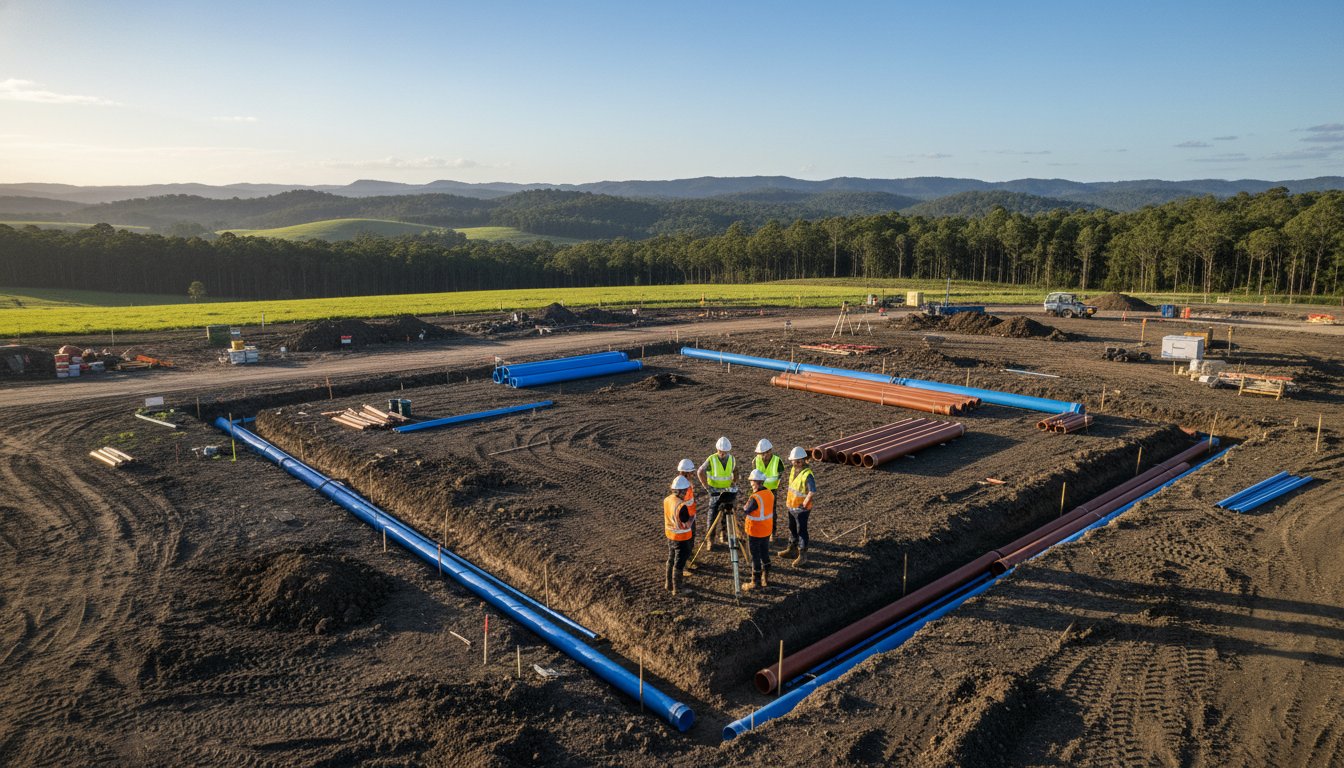
In early 2024, a residential development project in the Clarence Valley stalled for 22 days because the initial contractor failed to account for the specific utility standards required by the local council. You likely agree that regional infrastructure projects often suffer from these avoidable delays and poorly organised worksites that compromise safety. Opaque quotes from large contractors often leave you guessing about the final bill. We believe you deserve a more straightforward approach to civil plumbing that prioritises honesty over high margins.
This reference guide provides a clear roadmap for your 2026 developments. It ensures your infrastructure meets every regional standard from Byron Shire to the Clarence Valley while maintaining total financial clarity. We will examine the specific compliance hurdles in Northern NSW, the benefits of our transparent hourly labour and material markup model, and the exact steps needed to deliver a compliant, high-quality site on schedule.
Key Takeaways
- Understand the critical scale differences between residential work and large-scale civil plumbing infrastructure to ensure your regional subdivision has a reliable backbone.
- Learn how to navigate complex council requirements and the North Coast Regional Plan 2041 to keep your development compliant and on schedule across the Northern Rivers.
- Discover the technical requirements for installing major water supply mains and complex gravity sewer systems, including pump stations and rising mains.
- Eliminate hidden contingencies by adopting a radical transparency model based on hourly labour and material markups for fairer, more predictable project outcomes.
- Identify the benefits of partnering with a straight-shooting local expert capable of managing everything from tight-access works to major regional earthworks.
Defining Civil Plumbing in the Northern NSW Context
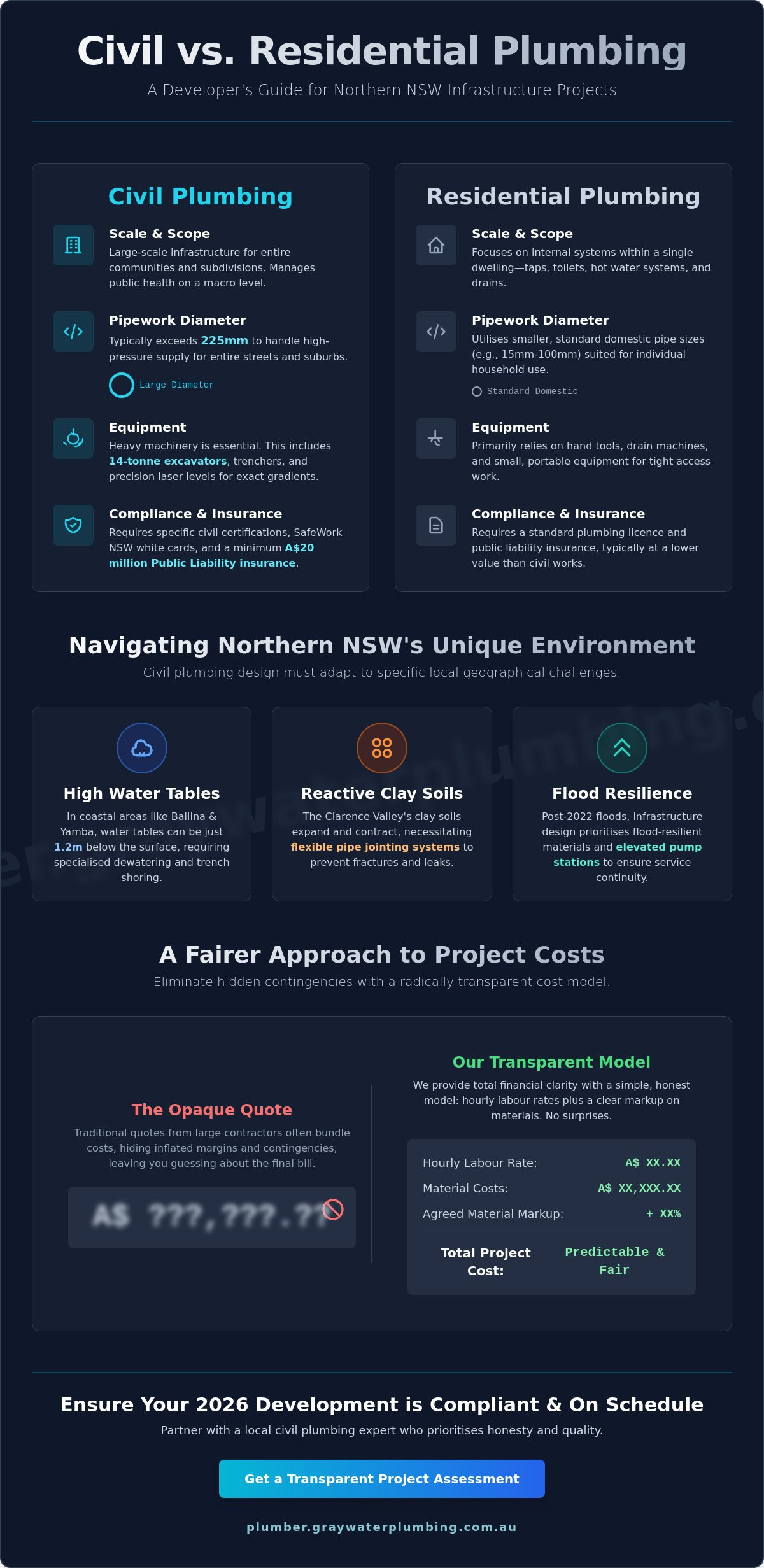
Civil plumbing serves as the essential backbone for any regional development project across Northern NSW. While a residential plumber focuses on the internal systems of a single dwelling, civil works involve the large-scale infrastructure that connects entire communities. This discipline includes the installation of trunk mains, reticulation systems, and complex stormwater networks. These projects rely on Sanitary engineering principles to ensure that waste is managed safely and water supply remains consistent across high-density subdivisions. By managing these large-scale systems, civil plumbers protect the local environment from contamination and uphold public health standards for thousands of residents.
Civil vs. Residential Plumbing: Key Distinctions
The scale of civil plumbing is significantly larger than standard domestic work. Subdivisions often require pipework with diameters exceeding 225mm, designed to handle high-pressure requirements for entire streets. We use heavy machinery like 14-tonne excavators, trenchers, and precision laser levels to maintain the exact gradients needed for gravity-fed sewerage. In NSW, civil contractors must hold specific certifications and insurance. This includes Public Liability insurance typically valued at A$20 million and current SafeWork NSW white cards for all site personnel. Every project must comply with the Plumbing Code of Australia and local council engineering specifications.
Regional Geography and Plumbing Challenges
Northern NSW presents unique environmental challenges that dictate specific plumbing designs. In coastal towns like Yamba and Ballina, plumbers must manage high water tables that often sit just 1.2 metres below the surface. This requires dewatering equipment and specialised shoring during trenching to prevent collapses. The Clarence Valley often features reactive clay soils that shift with moisture changes. We use flexible jointing systems here to prevent pipe failure during soil movement. Following the 2022 floods, infrastructure design in the Northern Rivers now focuses on flood-resilient materials and elevated pump stations to ensure service continuity during extreme weather events.
The role of a civil plumber extends beyond simple pipe laying. It's about creating a sustainable environment where regional growth doesn't compromise the local ecosystem. By implementing strict erosion and sediment control plans during the construction phase, we prevent silt from entering our river systems. This methodical approach ensures that new developments in 2026 are built on a foundation of reliability and environmental accountability.
Core Civil Infrastructure Services for Regional Subdivisions
Civil plumbing forms the backbone of any new regional development in Northern NSW. As populations in areas like the Clarence Valley and Richmond Valley grow, the demand for robust utility networks increases. Developers must ensure that every pipe and fitting aligns with the NSW plumbing code and standards to secure council sign-off and long-term viability. This infrastructure is a permanent investment that dictates the safety and health of the future community.
Water Supply and Reticulation
Connecting a new subdivision to the local council water main requires technical precision. It isn't just about laying pipe; it involves rigorous pressure testing and chlorination to ensure the water is safe for the first residents. We install bulk water meters and backflow prevention devices to protect the wider municipal supply from contamination. These components are vital for maintaining hydraulic integrity across the entire project. Our team focuses on a methodical installation process that prevents leaks and pressure drops before the first house is even built.
Sewerage and Wastewater Systems
Managing wastewater in regional blocks often involves deep excavation for gravity-fed sewer lines. These systems rely on specific gradients to function without mechanical assistance. When the terrain doesn't allow for gravity flow, we construct pump stations and rising mains to move waste effectively. For unsewered regional blocks, we specialise in septic tank installation clarence valley, ensuring these systems meet local environmental regulations. Every manhole and inspection chamber is built to withstand decades of use, following a linear progression from excavation to final testing.
Stormwater and Drainage Management
Intense weather events in Northern NSW make stormwater management a priority for any civil plumbing project. We install on-site detention (OSD) systems to control the rate of runoff, which prevents local creek systems from being overwhelmed during heavy rain. Gross pollutant traps (GPTs) are integrated to catch debris and silt before it enters the environment. Large-bore drainage pipes and culvert construction ensure that even during peak rainfall, the site remains stable and flood-resistant. This proactive approach to drainage protects both the development and the surrounding ecosystem.
Commercial and multi-residential sites require dedicated fire service installations. This includes high-pressure hydrants and sprinkler system feeds that meet strict safety benchmarks. Our approach focuses on transparent billing, where we break down costs by hourly labour and material markup. This gives developers a clear view of their infrastructure investment without hidden fees. If you're planning a new project, you can consult with our regional experts to ensure your civil plumbing meets all 2026 requirements.
Navigating Council Compliance in the Northern Rivers
Local civil plumbing projects must align with the North Coast Regional Plan 2041, which sets the framework for delivering 49,000 new homes across the region over the next two decades. Developers and contractors need to secure Section 68 approvals under the Local Government Act 1993 before any water, sewerage, or stormwater works commence. These approvals aren't just bureaucratic hurdles; they ensure that new infrastructure integrates safely with existing municipal networks. We've seen that clear communication regarding infrastructure contributions is vital, as these developer charges fund the essential upgrades required to support regional growth.
The final stage of any project involves the submission of "As-Constructed" drawings. These digital records provide the exact GPS coordinates and depth of all installed assets. Councils like Ballina and Byron won't issue a Subdivision Certificate until these plans are verified. Accuracy here is non-negotiable, as incorrect data leads to costly service strikes during future maintenance or domestic connections.
Council-Specific Infrastructure Standards
Clarence Valley, Byron Shire, and Ballina Shire each maintain unique technical specifications that dictate how civil plumbing systems are built. While all shires generally follow the Northern Rivers Local Government Development Design and Construction Manual, variations in pipe material are common. For example, Byron Shire often mandates Ductile Iron Concrete Lined (DICL) piping in specific high-pressure zones, whereas Ballina might permit PVC-O for reticulation lines in stable soil conditions. We organise our workflows around mandatory hold-point inspections. You can't backfill a trench or pour concrete thrust blocks until a council inspector has physically verified the pipe bedding and alignment.
Environmental Compliance and Protection
Protecting the Richmond and Clarence River catchments requires strict adherence to Erosion and Sediment Control (ESC) plans. Any site disturbance exceeding 250 square metres requires robust measures like sediment fences and stabilised entry points to prevent runoff. In many parts of Northern NSW, managing acid sulfate soils (ASS) is a primary concern during deep drainage works. When these soils are exposed to air during excavation, they can release sulphuric acid into the groundwater. We manage this by testing soil pH levels on-site and applying agricultural lime at specific neutralisation rates to protect the local ecosystem and the structural integrity of the new pipes.
Managing Civil Project Costs through Radical Transparency
Civil plumbing projects in Northern NSW often face budget blowouts because of traditional "lump sum" quotes. These fixed-price agreements usually include a 15% to 25% contingency buffer designed to protect the contractor's margin. If the project runs smoothly, the developer pays for risks that never materialised. If the project hits a snag, the contractor might be tempted to rush the work to avoid losing money. We believe this creates a conflict of interest that doesn't serve the project or the client.
The Hourly Labour and Material Markup Model
Transparent billing is the foundation of a functional project partnership. By using an hourly labour and material markup model, we ensure you only pay for the work actually performed. We pass through material costs without hidden loading, which means you benefit directly from our trade pricing. This model is particularly effective for managing "latent conditions" like unexpected rock layers or high water tables common in coastal developments. Instead of a contractor guessing how much rock they might hit and charging you for the worst-case scenario, you pay for the exact time spent on excavation. It's a fairer way to do business that keeps the focus on quality rather than speed.
Budgeting for Civil Plumbing in 2026
Accurate budgeting for civil plumbing requires an understanding of regional cost drivers. In 2026, the primary factors affecting your bottom line include the depth of excavation, the presence of hard rock, and the complexity of traffic management plans required by local councils. For developers navigating these transport requirements, ML Traffic Engineers Australia offers professional guidance on trip generation and planning. When you review a quote for a new home plumbing development, look for a clear breakdown of these variables. We use value engineering to identify cost-effective ways to meet strict council standards. This might involve re-routing lines to avoid heavy rock or choosing materials that offer better longevity for the specific soil conditions of the Northern Rivers.
Tracking project milestones is essential to avoid budget blowouts. We provide regular updates so you can see exactly where the labour and materials are being utilised. This level of detail allows developers to adjust their financial forecasts in real-time. Additionally, we advocate for the value of preventative maintenance for newly installed assets. Scheduling a check of backflow valves and stormwater systems six months after installation ensures that the civil infrastructure remains in peak condition as the rest of the build progresses.
Partnering with Graywater Plumbing for Civil Projects
Graywater Plumbing approaches civil plumbing with a practical, no-nonsense mindset. We understand that regional developments in Northern NSW require more than just technical skill; they demand a partner who communicates clearly and respects the project timeline. Our team manages a diverse range of civil requirements, from intricate tight-access installations in established town centres to major earthworks for new commercial subdivisions. We maintain clean, organised sites because a tidy workspace is a safe workspace. Whether the project is located in Yamba, Grafton, Ballina, or Byron Bay, we bring the same level of disciplined craftsmanship to every square metre of the site.
Our fleet is equipped to handle the rigorous demands of 2026 regional construction standards. We operate a range of machinery that allows us to transition between heavy-duty excavation and delicate utility installations without delay. This versatility is essential for government and commercial contracts where site conditions can change rapidly. We're straight-shooters who value integrity, which is why we provide upfront clarity on our capabilities and our "Hourly Labour and Material Markup" billing structure from the very beginning.
Our Civil Project Methodology
Success on a civil site begins long before the first trench is dug. We prioritise comprehensive pre-construction planning and develop site-specific safety management plans to mitigate risks before they become issues. Our technicians use the latest GPS and laser technology to ensure precision workmanship on every run of pipe. This high-level accuracy reduces material waste and prevents the need for costly rework. We keep the communication flow simple and frequent. Site managers and developers receive regular updates so they always have an accurate picture of the hydraulic infrastructure status. We don't hide behind technical jargon; we provide the facts so you can keep the project moving forward.
Why a Local Specialist Matters
Choosing a regional expert provides tangible advantages for active civil sites. When an emergency repair is needed on a live site, our response time is measured in minutes, not hours. We're already on the ground in the Northern Rivers, which means we can be on-site at a moment's notice. Our long-standing relationships with local council inspectors in Ballina and Byron Bay help streamline the certification and approval process. We understand the specific regional soil conditions and environmental regulations that outsiders often overlook.
By partnering with us, you're also supporting the local economy. We prioritise regional employment and invest back into the communities where we live and work. Our transparent approach ensures you get honest value for every dollar spent on your civil plumbing requirements. This commitment to the local area, combined with our professional expertise, makes us a dependable partner for any regional development project.
Securing the Future of Your Northern NSW Development
Successful regional subdivisions in 2026 depend on more than just moving dirt. They require a rigorous approach to council compliance, particularly within the specific regulatory frameworks of the Clarence Valley and Byron Shire. Getting your civil plumbing right from the start prevents costly rework and ensures your infrastructure meets the long-term demands of the Northern Rivers climate. We've built our reputation on a straightforward hourly labour and material markup model. This approach gives developers full visibility over every dollar spent without the padding often found in traditional flat-rate quotes.
Managing a worksite is a high-stakes environment where delays impact the bottom line. Our team provides 24/7 emergency support to keep active projects moving, ensuring that technical hurdles don't turn into weeks of expensive downtime. By choosing a partner that prioritises radical transparency and local expertise, you're investing in the structural integrity of your development. We're ready to help you navigate the complexities of regional infrastructure with honest advice and reliable craftsmanship.
Discuss your Northern NSW civil project with our straight-shooting team today.
We look forward to helping you get your next project off the ground with confidence.
Frequently Asked Questions
What is the difference between civil plumbing and standard commercial plumbing?
Civil plumbing involves the installation and maintenance of large-scale infrastructure that connects a development to the public utility network. This includes water mains, sewer extensions, and major stormwater systems. Standard commercial plumbing focuses on the internal pipework and fixtures within a building's footprint. While commercial work deals with the structure itself, civil plumbing ensures the entire site integrates safely with regional council assets.
Do I need a special licence for civil plumbing works in NSW?
Yes, any contractor performing civil plumbing in NSW must hold a valid licence from NSW Fair Trading with specific endorsements for drainage or water plumbing. For projects involving public infrastructure, the plumber often needs to be an accredited provider for the local water authority. Our team maintains all required certifications to ensure your project meets the strict safety standards set by the Plumbing Code of Australia.
How much does civil plumbing typically cost for a small subdivision?
Costs depend heavily on the site's proximity to existing mains and the soil conditions. According to 2024 industry benchmarks, a basic four-lot subdivision connection usually starts at A$25,000. This figure can increase if the site requires rock excavation or complex pump stations. We provide a clear breakdown of these costs through our hourly labour and material markup model, ensuring you only pay for the specific resources used on your site.
What is a "peg out" and why is it required for civil projects?
A "peg out" is a physical survey where a technician marks the exact location and depth of underground sewer or water assets on your property. It’s a mandatory step for civil plumbing projects to prevent accidental damage during excavation. NSW regulations require a minimum 1.5-metre clearance from most public pipes, and a peg out provides the precise data needed to design your site layout without encroaching on these protected zones.
How do Northern NSW councils handle stormwater drainage approvals?
Councils such as Byron Shire and Tweed Shire require a Section 68 approval under the Local Government Act 1993 before any stormwater works begin. You must submit a detailed plan showing how runoff will be managed to prevent impact on neighbouring properties. These councils often require on-site detention (OSD) systems for new developments to ensure the existing public drainage network isn't overwhelmed during heavy rain events.
Can Graywater Plumbing handle both the civil infrastructure and the internal plumbing for new builds?
We manage the entire plumbing scope from the initial civil infrastructure in the ground to the final internal fit-out. Handling both phases allows us to maintain better quality control and prevents the scheduling conflicts that happen when using multiple contractors. If your project requires specialized internal systems like energy-efficient water-based heating, you can learn more about advanced installation standards. We apply our transparent hourly labour and material markup billing to every stage, so you have a consistent and predictable financial record for the whole project.
What heavy equipment is required for a standard civil plumbing project?
A typical civil plumbing project requires a 5-tonne to 13-tonne excavator for trenching and laying large-diameter pipes. We also use specialized shoring boxes to keep workers safe in deep trenches and laser levels to achieve the exact gradients needed for gravity-fed sewers. For regional Northern NSW sites with difficult access, we might also use a skid-steer loader to move materials and manage backfilling efficiently.
How long does the civil plumbing phase usually take in a development?
The civil plumbing phase for a standard residential development usually takes between three and six weeks to complete. This timeframe covers everything from the initial site preparation to the final council inspections and pressure testing. While weather conditions or hidden rock can impact the schedule, we provide regular progress reports to ensure your broader construction timeline stays as close to the original plan as possible.